
How AI is Helping Mushroom Growers Control Climate
The Problem We All Face
Well I killed a batch of oyster mushrooms because I didn’t realize how quickly humidity could tank. Went from 85% to 60% overnight—took me three days to notice. By then, the fruiting bodies had already aborted. That’s when I started thinking: what if something could watch these conditions continuously and actually do something before I messed up?
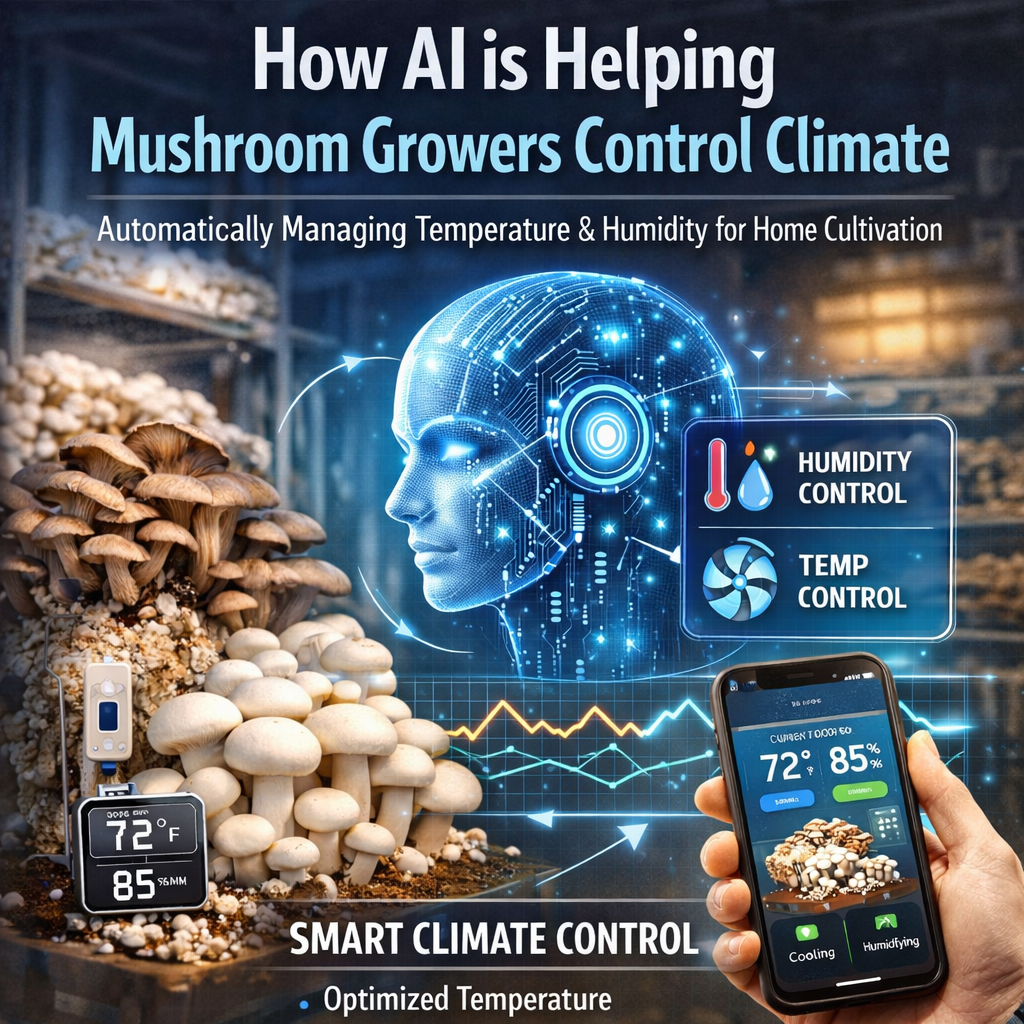
That’s where AI climate control comes in. And no, I’m not talking about some sci-fi setup—I mean actual sensor networks and feedback systems that have gotten smart enough to run themselves.
How This Actually Works
Here’s the technical reality: growing oyster, shiitake, or wine cap mushrooms requires holding very specific ranges. For fruiting, you typically need 80–95% humidity, 55–75°F, and decent FAE (fresh air exchange). Traditional solutions—a basic thermostat, a humidifier you set and forget—don’t cut it. They’re dumb. They overshoot. They undershoot.
AI systems work differently. They don’t just react. A decent setup uses:
- Multiple sensors - (not just one thermometer). You get readings from different zones of your grow chamber.
- Pattern recognition - the system learns that your space naturally drops humidity around 3 PM because of afternoon temperature spikes. So it pre-adjusts before it becomes a problem.
- Micro-adjustments - instead of your humidifier blasting on and off like a freight train, AI gradually increases misting cycles or exhaust fans.
Companies like AC Infinity AC Infinity AI Grow System Compact and some of the newer home automation setups now integrate machine learning. They learn your specific space’s thermal mass, your substrate’s water retention, seasonal changes. Over time, they make better decisions than you do manually.
Where This Actually Helps
Look, let’s be honest: AI doesn’t magically make bad substrate grow mushrooms. It won’t save a contaminated batch. But it might remove the most frustrating failure point—inconsistent conditions during the critical fruiting phase.
If you’ve got decent genetics and decent spawn, the difference between 40% success and 85% success often comes down to humidity stability and temperature swings. That’s what automated climate control can help solve. I an not convinced its the silver bullet around these but it may help. You also get your time back. I used to check my grow room twice a day, especially during fruiting. Now? I check my phone once a day. That saved time compounds you can actually scale to more fruiting chambers without going insane.
One thing to note: these systems cost real money. Entry-level AI-integrated controllers run $300–600. That’s worth it if you’re running multiple chambers or doing this seriously. If you’re growing one batch as a hobby, a $40 digital hygrometer and manual adjustments is still your answer.
The Practical Stuff
If you want to try this route, start small. A few sensor nodes, a hub that learns your space. There’s also DIY options using Arduino and open-source climate monitoring if you’re comfortable with that and have the time. I tried this route and let me tell you its not worth the time. By the time you get a all the parts put it all together and manage the software you lost so many hours its just not for most people. Its like 3d printing, once the Bambu Labs machines came out I spend almost zero time fixing my printer, I print and enjoy it. I used to think that part of 3d printing was managing your printer ever time you wanted to print. I dont want to do that anymore and thats why I think the AC Infinity setup is key.
The best approach? Run it in parallel with manual checks for the first month. Watch how it handles your space. Learn its patterns.
Climate control is unglamorous work, but it’s where most home growers actually lose their harvests. AI can’t replace good technique—but it can keep your conditions locked in while you focus on everything else.